
Please share:

Is the “Surprise Question” meaningful?

The question “Would I be surprised if this patient died in the next 12 months?” aims to identify patients at high risk of death who could benefit from palliative care. But how reliable is this subjective assessment?

A Systematic Review (2017) analyzed 17 studies on this topic. The result showed a sensitivity of 67% and a specificity of 80%. The authors concluded that the “Surprise Question” has poor to moderate accuracy in predicting death within the next 12 months. However, they emphasized that this question is neither “good” nor “bad” but should be supplemented with clinical indicators (which some palliative care scores already do).

An older BMJ Studie (2000) surveyed 343 doctors on how long 468 terminally ill patients (at the time of their hospice referral; average age 69) were likely to live. The actual average survival time of these patients was 24 days. Although experienced doctors were more accurate, most were still off the mark:
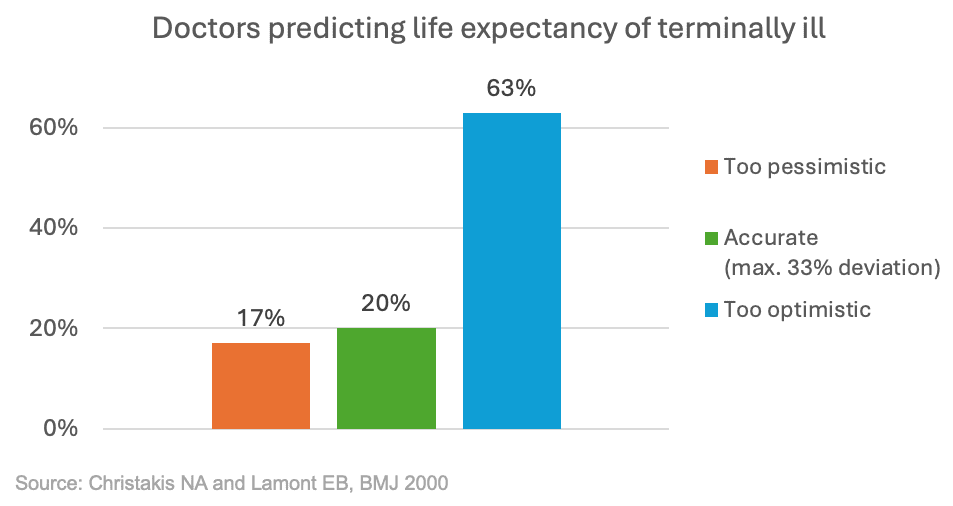
Conclusion:

The “Surprise Question” is simple and quick, but it is often inaccurate. It seems that we doctors are not particularly good at intuitively assessing the risk of death, and we tend to be too optimistic.


Disclaimer: This site and its related services are for informational purposes only and do not provide medical advice. The use of any information provided is solely at your own risk. Neither the site owner nor site contributors can accept responsibility for any loss, damage or injury that arises from the use of this website or services. More information here.

Essential Updates
“exciting, practical, evidence-based, short”
2-min reads by & for GPs.
Free, no pharma money.

More Info & Sign-up.

More to explore

Vitamin C for Fatigue? A 90-Year-Old Myth & The Current Evidence

Is high‑dose vitamin C the answer to chronic fatigue? The 1930s marketing campaign that sparked this belief still shapes patient requests today. This post unpacks the myth’s origins, reviews the latest evidence—from colds and wound healing to ME/CFS and cancer—and closes with practical counseling tips for family physicians. Spoiler: the data remain thinner than you might expect.

Key Facts GPs Should Know About GLP-1 Analogs

As demand is high and availability is low: which patients should get GLP-analogs first? What are the true benefits and side effects? Here you can find everything you need to know: a readable summary of the key research studies!

Fishhook Removal Techniques for GPs

Discover four essential fishhook removal techniques, when and how to apply them safely, and crucial aftercare tips. Includes expert advice, practical videos, and evidence-based guidance on antibiotic use.
Obesity Management

Why Most Doctors Are Wrong About Obesity Management

Most doctors are managing obesity based on opinion, not on evidence. This easy-to-read summary of key studies might challenge your thinking and clinical practice…

Teach-Back for GPs: An Evidence-Based Communication Tool

The Teach-Back-Method helps Family Doctors to improve patient understanding and recall. It’s a simple communication tool, it’s evidence-based and it’s quick. Here you can read everything you need to know to apply it tomorrow morning.

Discover more from Family Medicine Initiative

Subscribe now to keep reading and get access to the full archive.

Continue reading